History Of Robots-
Concepts of artificial servants and companions date at least as far back as the ancient legends of Cadmus, who sowed dragon teeth that turned into soldiers, and the myth of Pygmalion whose statue of Galatea came to life. Many ancient mythologies included artificial people, such as the talking mechanical handmaidens built by the Greek god Hephaestus (Vulcan to the Romans) out of gold the claygolems of Jewish legend and clay giants of Norse legend. Chinese legend relates that in the 10th century BC, Yan Shi made an automaton resembling a human in an account from the Lie Zi text.
In Greek mythology, Hephaestus created utilitarian three-legged tables that could move about under their own power and a bronze man, Talos, that defended Crete. Talos was eventually destroyed by Media who cast a lightning bolt at his single vein of lead. To take the golden fleece Jason was also required to tame two fire breathing bulls with bronze hooves; and like Cadmus he sowed the teeth of a dragon into soldiers.
The Indian Lokapannatti (11th/12th century) tells the story of King Ajatashatru ofMagadha who gathered the Buddhas relics and hid them in an underground stupa.The Buddhas relics were protected by mechanical robots (bhuta vahana yanta), from the kingdom of Roma visaya; until they were disarmed by King Ashoka. In the Egyptian legend of Rocail, the younger brother of Seth created a palace and a sepulcher containing autonomous statues that lived out the lives of men so realistically they were mistaken for having souls.
In Christian legend, several of the men associated with the introduction of Arabic learning (and, through it, the reintroduction of Aristotle and Hero's works) to medieval Europe devised brazen heads that could answer questions posed to them.Albertus Magnus was supposed to have constructed an entire android who could perform some domestic tasks but was destroyed by Albert's student Thomas Aquinas for disturbing his thought The most famous legend concerned a bronze head devised by Roger Bacon which was destroyed or scrapped after he missed its moment of operation.
Automata were popular in the imaginary worlds of medieval literature. For instance, the Middle Dutch tale Roman van Walewein ("The Romance of Walewein", early 13th century) described mechanical birds and angels producing sound by means of systems of pipes.
Remote-controlled & Humanoid robots-
Remotely operated vehicles were demonstrated in the late 19th Century in the form of several types of remotely controlled torpedos. The early 1870s saw remotely controlled torpedos by John Ericsson (pneumatic), John Louis Lay (electric wire guided), and Victor von Scheliha (electric wire guided).
The Brennan torpedo, invented by Louis Brennan in 1877 was powered by two contra-rotating propellors that were spun by rapidly pulling out wires from drums wound inside the torpedo. Differential speed on the wires connected to the shore station allowed the torpedo to be guided to its target, making it "the world's firstpractical guided missile". In 1897 the British inventor Ernest Wilson was granted a patent for a torpedo remotely controlled by "Hertzian" (radio) waves and in 1898 Nikola Tesla publicly demonstrated a wireless-controlled torpedothat he hoped to sell to the US Navy.
Archibald Low, known as the "father of radio guidance systems" for his pioneering work on guided rockets and planes during the First World War. In 1917, he demonstrated a remote controlled aircraft to the Royal Flying Corps and in the same year built the first wire-guided rocket.
The term 'robot' was first used to denote fictional automata in a 1921 play R.U.R. by theCzech writer, Karel Čapek. The word 'robot' is of Czech origin.
In 1928, one of the first humanoid robots was exhibited at the annual exhibition of the Model Engineers Society in London. Invented by W. H. Richards, the robot Eric's frame consisted of an aluminium body of armour with eleven electromagnets and one motor powered by a twelve-volt power source. The robot could move its hands and head and could be controlled through remote control or voice control.
Westinghouse Electric Corporation built Televox in 1926; it was a cardboard cutout connected to various devices which users could turn on and off. In 1939, the humanoid robot known as Elektro was debuted at the 1939 New York World's Fair. Seven feet tall (2.1 m) and weighing 265 pounds (120.2 kg), it could walk by voice command, speak about 700 words (using a 78-rpm record player), smoke cigarettes, blow up balloons, and move its head and arms. The body consisted of a steel gear, cam and motor skeleton covered by an aluminum skin. In 1928, Japan's first robot, Gakutensoku, was designed and constructed by biologist Makoto Nishimura.

Modern autonomous robots-
The first electronic autonomous robots with complex behaviour were created by William Grey Walter of the Burden Neurological Institute at Bristol, England in 1948 and 1949. He wanted to prove that rich connections between a small number of brain cells could give rise to very complex behaviors - essentially that the secret of how the brain worked lay in how it was wired up. His first robots, named Elmer and Elsie, were constructed between 1948 and 1949 and were often described as tortoises due to their shape and slow rate of movement. The three-wheeled tortoise robots were capable ofphototaxis, by which they could find their way to a recharging station when they ran low on battery power.
Walter stressed the importance of using purely analogue electronics to simulate brain processes at a time when his contemporaries such as Alan Turing and John von Neumann were all turning towards a view of mental processes in terms ofdigital computation. His work inspired subsequent generations of robotics researchers such as Rodney Brooks, Hans Moravec and Mark Tilden. Modern incarnations of Walter's turtles may be found in the form of BEAM robotics.
The first digitally operated and programmable robot was invented by George Devol in 1954 and was ultimately called the Unimate. This ultimately laid the foundations of the modern robotics industry. Devol sold the first Unimate to General Motors in 1960, and it was installed in 1961 in a plant in Trenton, New Jersey to lift hot pieces of metal from a die casting machine and stack them. Devol’s patent for the first digitally operated programmable robotic arm represents the foundation of the modern robotics industry.
The first palletizing robot was introduced in 1963 by the Fuji Yusoki Kogyo Company. In 1973, a robot with six electromechanically driven axes was patented by KUKA robotics in Germany, and the programmable universal manipulation arm was invented by Victor Scheinmanin 1976, and the design was sold to Unimation.
Commercial and industrial robots are now in widespread use performing jobs more cheaply or with greater accuracy and reliability than humans. They are also employed for jobs which are too dirty, dangerous or dull to be suitable for humans. Robots are widely used in manufacturing, assembly and packing, transport, earth and space exploration, surgery, weaponry, laboratory research, and mass production of consumer and industrial goods.
Modular Robots-
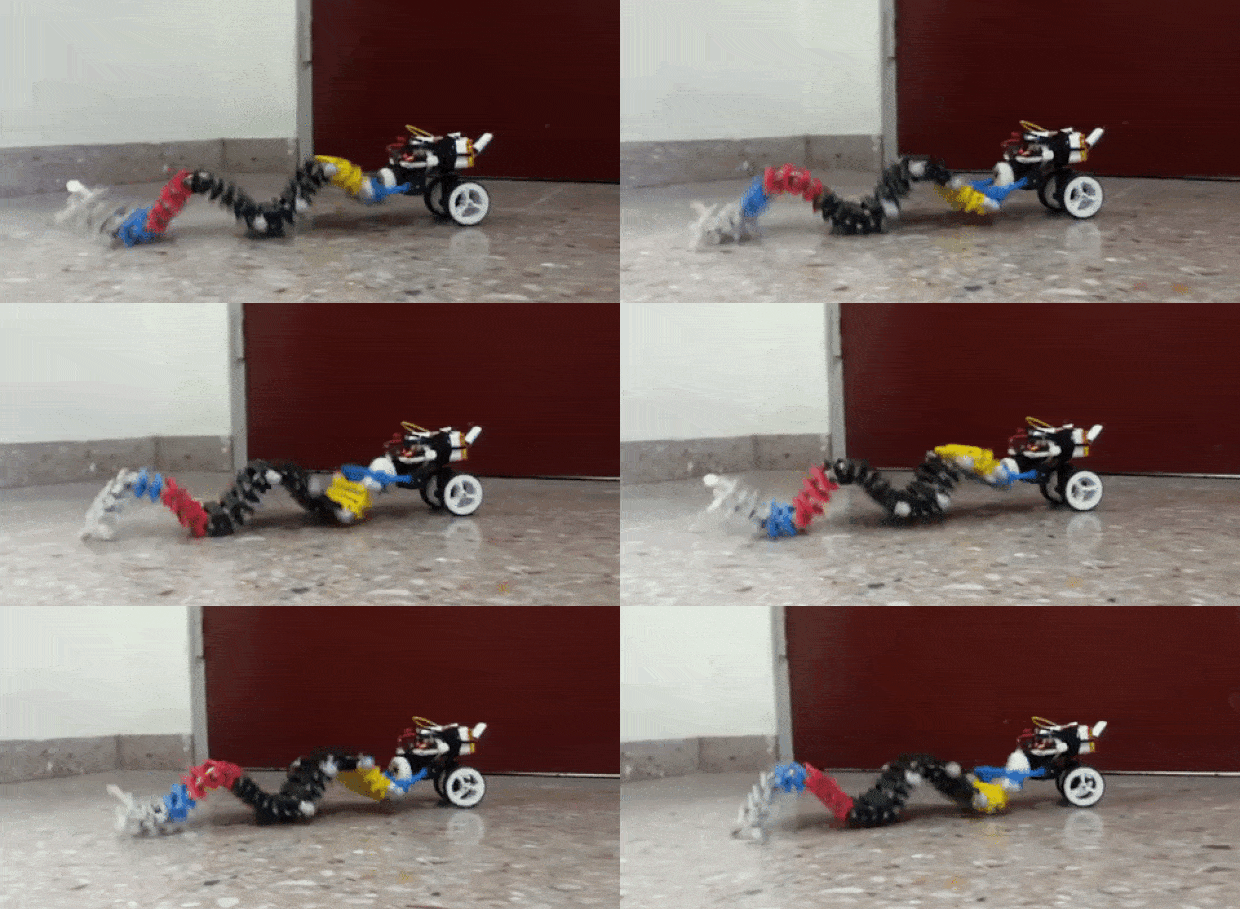
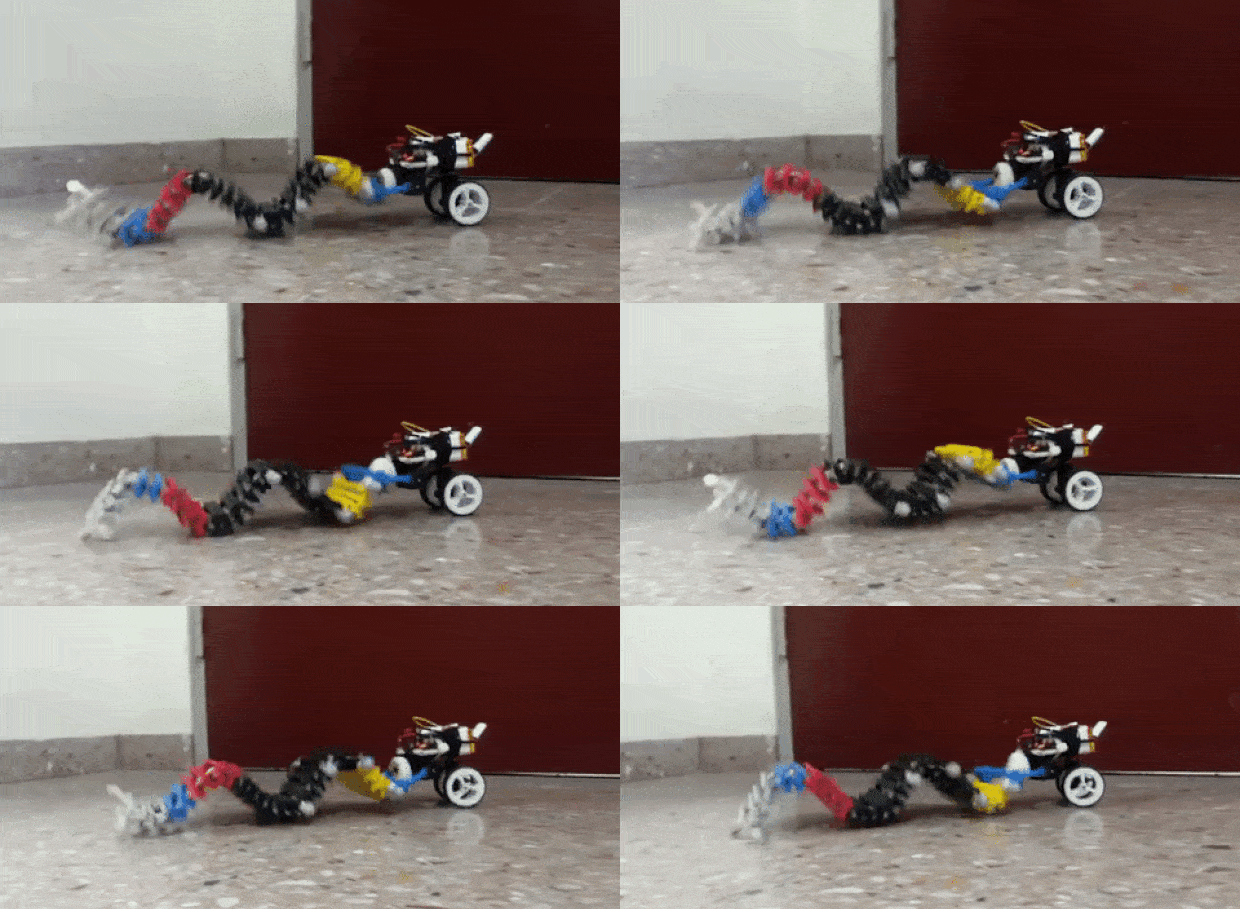
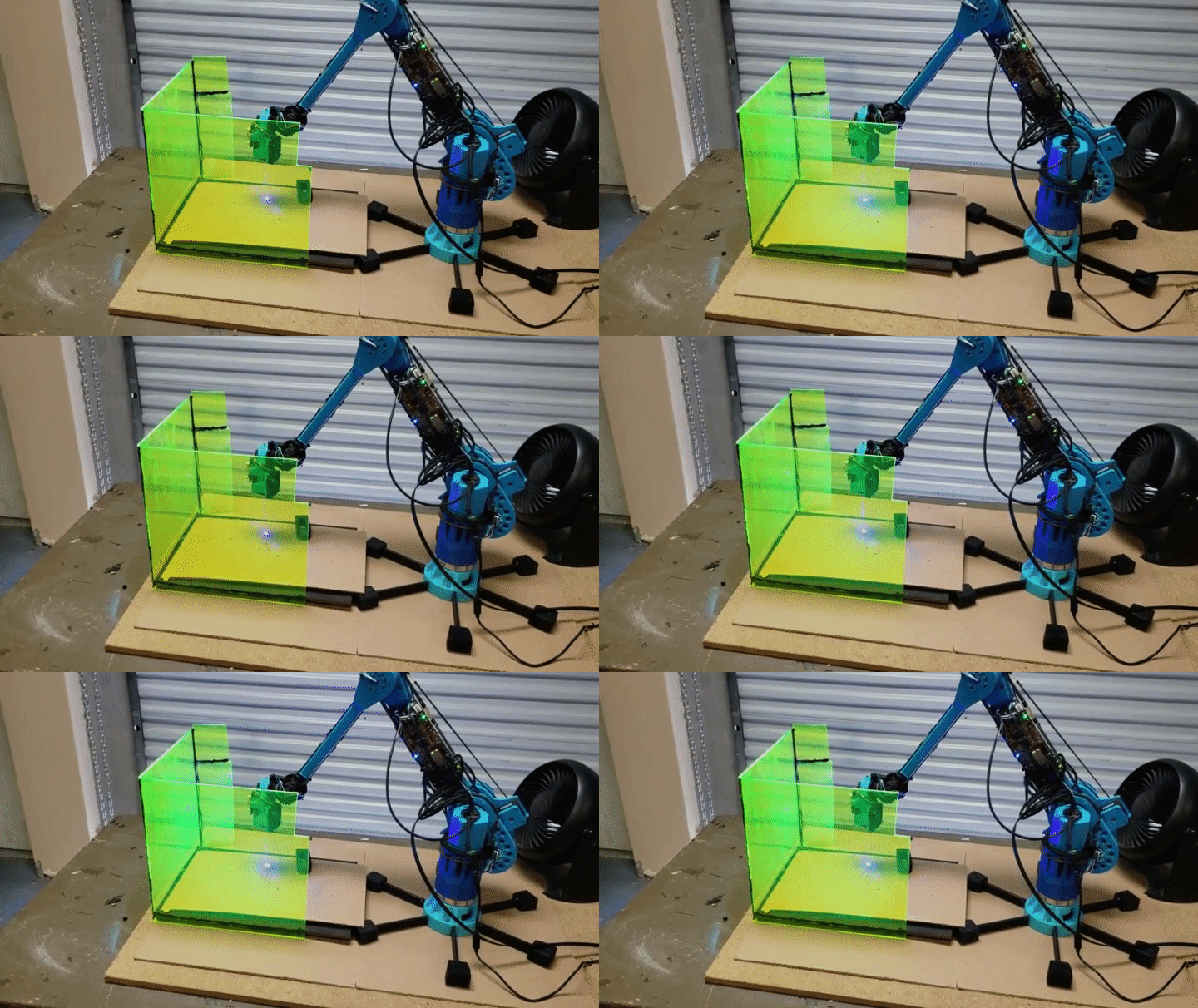
Modular robots are a new breed of robots that are designed to increase the utilization of robots by modularizing their architecture. The functionality and effectiveness of a modular robot is easier to increase compared to conventional robots. These robots are composed of a single type of identical, several different identical module types, or similarly shaped modules, which vary in size. Their architectural structure allows hyper-redundancy for modular robots, as they can be designed with more than 8 degrees of freedom (DOF). Creating the programming, inverse kinematics and dynamics for modular robots is more complex than with traditional robots. Modular robots may be composed of L-shaped modules, cubic modules, and U and H-shaped modules. ANAT technology, an early modular robotic technology patented by Robotics Design Inc., allows the creation of modular robots from U and H shaped modules that connect in a chain, and are used to form heterogeneous and homogenous modular robot systems. These “ANAT robots” can be designed with “n” DOF as each module is a complete motorized robotic system that folds relatively to the modules connected before and after it in its chain, and therefore a single module allows one degree of freedom. The more modules that are connected to one another, the more degrees of freedom it will have. L-shaped modules can also be designed in a chain, and must become increasingly smaller as the size of the chain increases, as payloads attached to the end of the chain place a greater strain on modules that are further from the base. ANAT H-shaped modules do not suffer from this problem, as their design allows a modular robot to distribute pressure and impacts evenly amongst other attached modules, and therefore payload-carrying capacity does not decrease as the length of the arm increases. Modular robots can be manually or self-reconfigured to form a different robot, that may perform different applications. Because modular robots of the same architecture type are composed of modules that compose different modular robots, a snake-arm robot can combine with another to form a dual or quadra-arm robot, or can split into several mobile robots, and mobile robots can split into multiple smaller ones, or combine with others into a larger or different one. This allows a single modular robot the ability to be fully specialized in a single task, as well as the capacity to be specialized to perform multiple different tasks.
Modular robotic technology is currently being applied in hybrid transportation, industrial automation, duct cleaning and handling. Many research centres and universities have also studied this technology, and have developed prototypes.
Military Robots-
Broadly defined, military robots date back to World War II and the Cold War in the form of the German Goliath tracked mines and the Soviet teletanks. The MQB-1 Predator drone was when "CIA officers began to see the first practical returns on their decade-old fantasy of using aerial robots to collect intelligence".
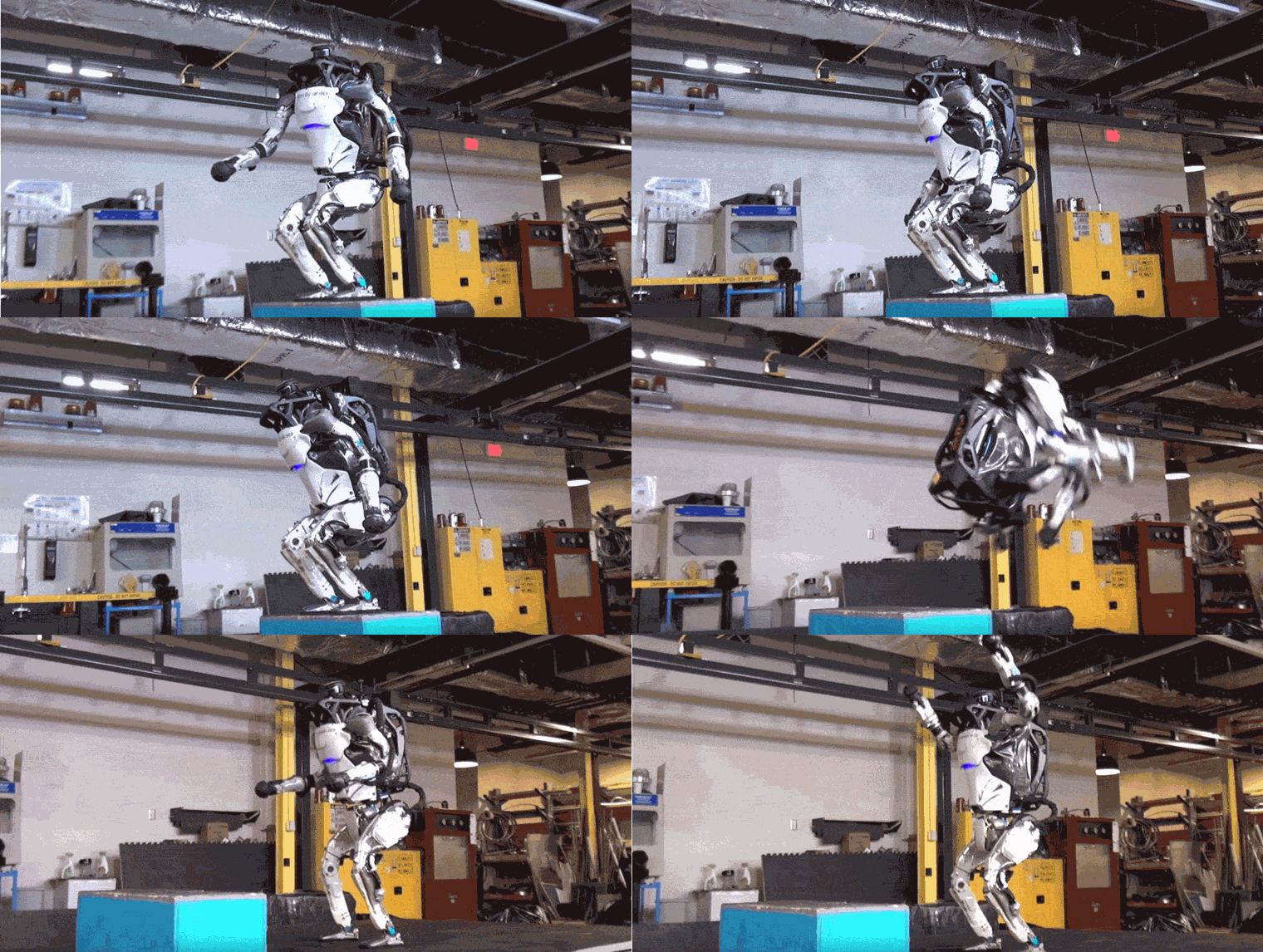
The use of robots in warfare, although traditionally a topic for science fiction, is being researched as a possible future means of fighting wars. Already several military robots have been developed by various armies.
Some believe the future of modern warfare will be fought by automated weapons systems. The U.S. Military is investing heavily in research and development towards testing and deploying increasingly automated systems. The most prominent system currently in use is the unmanned aerial vehicle (IAI Pioneer & RQ-1 Predator) which can be armed with Air-to-ground missiles and remotely operated from a command center in reconnaissance roles. DARPA has hosted competitions in 2004 & 2005 to involve private companies and universities to develop unmanned ground vehicles to navigate through rough terrain in the Mojave Desert for a final prize of 2 Million.
Artillery has seen promising research with an experimental weapons system named "Dragon Fire II" which automates loading and ballistics calculations required for accurate predicted fire, providing a 12-second response time to fire supportrequests. However, military weapons are prevented from being fully autonomous: they require human input at certain intervention points to ensure that targets are not within restricted fire areas as defined by Geneva Conventions for the laws of war.
There have been some developments towards developing autonomous fighter jets and bombers. The use of autonomous fighters and bombers to destroy enemy targets is especially promising because of the lack of training required for robotic pilots, autonomous planes are capable of performing maneuvers which could not otherwise be done with human pilots (due to high amount of G-Force), plane designs do not require a life support system, and a loss of a plane does not mean a loss of a pilot. However, the largest draw back to robotics is their inability to accommodate for non-standard conditions. Advances in artificial intelligence in the near future may help to rectify this.
Military robots include the SWORDS robot which is currently used in ground-based combat. It can use a variety of weapons and there is some discussion of giving it some degree of autonomy in battleground situations.
Unmanned combat air vehicles (UCAVs), which are an upgraded form of UAVs, can do a wide variety of missions, including combat. UCAVs are being designed such as the BAE Systems Mantis which would have the ability to fly themselves, to pick their own course and target, and to make most decisions on their own. The BAE Taranis is a UCAV built by Great Britain which can fly across continents without a pilot and has new means to avoid detection. Flight trials are expected to begin in 2011.
The AAAI has studied this topic in depth and its president has commissioned a study to look at this issue.
Some have suggested a need to build "Friendly AI", meaning that the advances which are already occurring with AI should also include an effort to make AI intrinsically friendly and humane.Several such measures reportedly already exist, with robot-heavy countries such as Japan and South Korea having begun to pass regulations requiring robots to be equipped with safety systems, and possibly sets of 'laws' akin to Asimov's Three Laws of Robotics. An official report was issued in 2009 by the Japanese government's Robot Industry Policy Committee. Chinese officials and researchers have issued a report suggesting a set of ethical rules, and a set of new legal guidelines referred to as "Robot Legal Studies." Some concern has been expressed over a possible occurrence of robots telling apparent falsehoods.
In Literature-
Robotic characters, androids (artificial men/women) or gynoids (artificial women), and cyborgs (also "bionic men/women", or humans with significant mechanical enhancements) have become a staple of science fiction.
The first reference in Western literature to mechanical servants appears in Homer'sIliad. In Book XVIII, Hephaestus, god of fire, creates new armor for the hero Achilles, assisted by robots. According to the Rieu translation, "Golden maidservants hastened to help their master. They looked like real women and could not only speak and use their limbs but were endowed with intelligence and trained in handwork by the immortal gods." Of course, the words "robot" or "android" are not used to describe them, but they are nevertheless mechanical devices human in appearance. "The first use of the word Robot was in Karel Čapek's play R.U.R. (Rossum's Universal Robots) (written in 1920)". Writer Karel Čapek was born in Czechoslovakia (Czech Republic).
Possibly the most prolific author of the twentieth century was Isaac Asimov (1920–1992) who published over five-hundred books. Asimov is probably best remembered for his science-fiction stories and especially those about robots, where he placed robots and their interaction with society at the center of many of his works. Asimov carefully considered the problem of the ideal set of instructions robots might be given in order to lower the risk to humans, and arrived at his Three Laws of Robotics: a robot may not injure a human being or, through inaction, allow a human being to come to harm; a robot must obey orders given it by human beings, except where such orders would conflict with the First Law; and a robot must protect its own existence as long as such protection does not conflict with the First or Second Law. These were introduced in his 1942 short story "Runaround", although foreshadowed in a few earlier stories. Later, Asimov added the Zeroth Law: "A robot may not harm humanity, or, by inaction, allow humanity to come to harm"; the rest of the laws are modified sequentially to acknowledge this.
According to the Oxford English Dictionary, the first passage in Asimov's short story "Liar!" (1941) that mentions the First Law is the earliest recorded use of the word robotics. Asimov was not initially aware of this; he assumed the word already existed by analogy with mechanics, hydraulics, and other similar terms denoting branches of applied knowledge.
Fears and concerns about robots have been repeatedly expressed in a wide range of books and films. A common theme is the development of a master race of conscious and highly intelligent robots, motivated to take over or destroy the human race. (See The Mechanical Man, The Terminator, Runaway, RoboCop, theReplicators in Stargate, the Cylons in Battlestar Galactica, the Cybermen andDaleks in Doctor Who, The Matrix, Enthiran and I, Robot.) Some fictional robots are programmed to kill and destroy; others gain superhuman intelligence and abilities by upgrading their own software and hardware. Examples of popular media where the robot becomes evil are 2001: A Space Odyssey, Red Planet and Enthiran. Another common theme is the reaction, sometimes called the "uncanny valley", of unease and even revulsion at the sight of robots that mimic humans too closely.Frankenstein (1818), often called the first science fiction novel, has become synonymous with the theme of a robot or monster advancing beyond its creator. In the TV show, Futurama, the robots are portrayed as humanoid figures that live alongside humans, not as robotic butlers. They still work in industry, but these robots carry out daily lives. Other problems may include events pertaining to robot surrogates (e.g. the movie Surrogates) where tissue of living organisms is interchanged with robotic systems. These problems can leave many possibilities where electronic viruses or an electro magnetic pulse (EMP) can destroy not only the robot but kill the host/operator as well.